I’m always deeply skeptical of this insistence that college offers “little benefit”. But I’ll happily concede that it functions as a bureaucratic hurdle, designed to favor the historically wealthy and socially entrenched over the impoverished and recently arrived.
The costs aren’t really what’s changed. It’s who bares the costs. Teaching a student today isn’t materially more expensive than it was 30 years ago. We’ve just shifted the demand for school revenues from state budgets to family pocketbooks as the number of students entering college has swelled.
It seems you’ve fundamentally misunderstood the problem. The actual cost to educate a person hasn’t changed much in the last 60 years. What has changed is the amount of student loan money available and how it needs to be paid back. Since student loan money is very easy to get, the prices of everything at a university have skyrocketed. Also student loan debt can’t be discharged in bankruptcy and since anyone can get one, the interest rates are insane.
There’s a bunch of downstream effects of these 2 facts. Since student loan debt needs to be paid, only education tracks that lead to landing a job matter which has dwindled the number of humanities professors making the education materially worse leading to less well rounded human beings.
What has changed is the amount of student loan money available and how it needs to be paid back.
Student loan money availability is only being made available because students are seen as a good financial investment. And that’s because college education yields higher salaries in the private sector.
Since student loan money is very easy to get, the prices of everything at a university have skyrocketed.
Private university tuition has far outpaced public university tuition, particularly in areas of the country where demand for public education is eclipsed by open seats at public universities. Students afforded low-cost public education don’t take on student debt, regardless of its availability.
Since student loan debt needs to be paid, only education tracks that lead to landing a job matter
That plays into a myth about education tracks as related to “landing a job”, when pretty much any basic degree plan - from English Lit to Comp Sci - gives you a better job prospect and higher future salary expectations than no-degree. Even bearing in mind the cost of servicing the debt, you’re better off completing a degree plan (or vocational program) than going directly into the workforce with merely a diploma.
Where people get fucked is in taking on debt, failing to complete the degree. At that point, they’re in the worst of both worlds. Or taking on private university debts that far outstrip what a public university would charge. The really nasty for-profit colleges love to lard you up with six figures of debt and plow the profits back into a blizzard of marketing.
But that has far less to do with available student debt (for-profits are more than happy to take the backend risk on loans and simply hound you with collectors) and more to do with predatory private for-profit schools specifically and weed-out courses in public universities generally.
Don’t forget college sports. If your parents are early Gen X or Boomers, college sports weren’t quite as big a deal - they weren’t quite as commercialized until the mid-80s, which started salaries for coaches and staff flying.
In many states, the highest paid public employee is a college football coach.
The poors can still get in if they are willing to become indebted wage slaves with a 6 figure debit for the next 20-30 years.
They can’t. Those schools are all scams. That’s the real ugliness. Private universities charging six figures also have some of the worst placement rates and poorest post-collegate incomes.
Just, don’t expect to get in to a social connection generator for nepo babies
Right. Because the degree is a social gatekeeper first and foremost.
In my experience I see a large part of the college degree is showing you can reliably show up and be in a state to use your brain. The knowledge you get is mostly not in classes but in the labs, most people don’t regularly do tests in work, the build things design things analyze things etc. Yes you learn some stuff in class but when you try to do it, fail, struggle, then figure out what’s wrong, correct it, and it works… That you will remember. It’s like watching a YouTube tutorial vs actually doing a task.
Four years, tens of thousands of dollars, and charades about studying math, literature and history, to get a certified as “able to show up to work sober.”
If that’s your idea of education, you’re part of the problem.
No, that’s not education. My point is from a job perspective that’s what’s most important. Most jobs won’t require anything you learn in calculus III or classical literature.
Let’s say you are getting a EE degree. In a lab while learning about ac circuits, learn to play with an oscilloscope and learn how to really use it. That’s most of the value. That’s something you will likely use in your job.


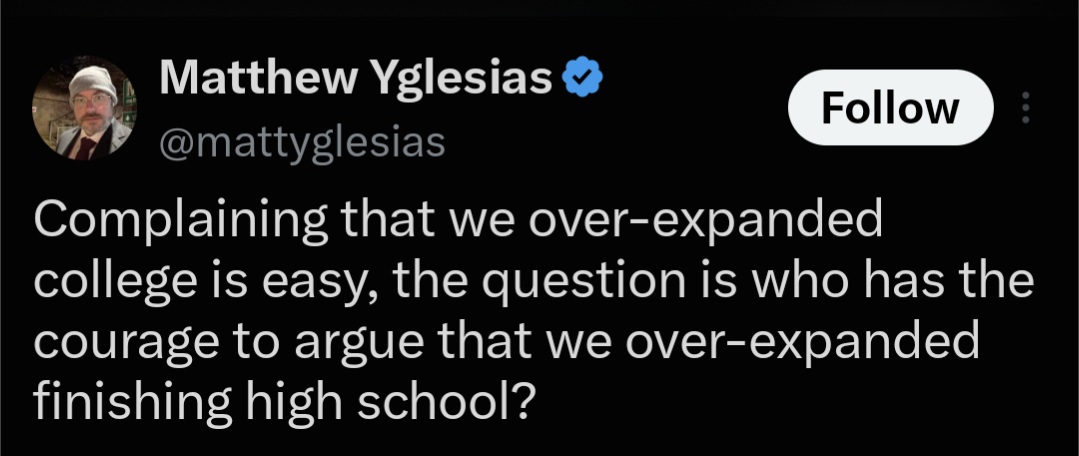
I’ll say we over expanded college in the wrong way. Turned it into a business. That greatly expanded the costs with little actual benefit.
I’m always deeply skeptical of this insistence that college offers “little benefit”. But I’ll happily concede that it functions as a bureaucratic hurdle, designed to favor the historically wealthy and socially entrenched over the impoverished and recently arrived.
No, the added costs have little benefit.
College itself is great. The added costs have not added to the experience.
The costs aren’t really what’s changed. It’s who bares the costs. Teaching a student today isn’t materially more expensive than it was 30 years ago. We’ve just shifted the demand for school revenues from state budgets to family pocketbooks as the number of students entering college has swelled.
It seems you’ve fundamentally misunderstood the problem. The actual cost to educate a person hasn’t changed much in the last 60 years. What has changed is the amount of student loan money available and how it needs to be paid back. Since student loan money is very easy to get, the prices of everything at a university have skyrocketed. Also student loan debt can’t be discharged in bankruptcy and since anyone can get one, the interest rates are insane.
There’s a bunch of downstream effects of these 2 facts. Since student loan debt needs to be paid, only education tracks that lead to landing a job matter which has dwindled the number of humanities professors making the education materially worse leading to less well rounded human beings.
Student loan money availability is only being made available because students are seen as a good financial investment. And that’s because college education yields higher salaries in the private sector.
Private university tuition has far outpaced public university tuition, particularly in areas of the country where demand for public education is eclipsed by open seats at public universities. Students afforded low-cost public education don’t take on student debt, regardless of its availability.
That plays into a myth about education tracks as related to “landing a job”, when pretty much any basic degree plan - from English Lit to Comp Sci - gives you a better job prospect and higher future salary expectations than no-degree. Even bearing in mind the cost of servicing the debt, you’re better off completing a degree plan (or vocational program) than going directly into the workforce with merely a diploma.
Where people get fucked is in taking on debt, failing to complete the degree. At that point, they’re in the worst of both worlds. Or taking on private university debts that far outstrip what a public university would charge. The really nasty for-profit colleges love to lard you up with six figures of debt and plow the profits back into a blizzard of marketing.
But that has far less to do with available student debt (for-profits are more than happy to take the backend risk on loans and simply hound you with collectors) and more to do with predatory private for-profit schools specifically and weed-out courses in public universities generally.
Well, it kind of is, though. Just look at the massively bloated administration budgets/staff.
Don’t forget college sports. If your parents are early Gen X or Boomers, college sports weren’t quite as big a deal - they weren’t quite as commercialized until the mid-80s, which started salaries for coaches and staff flying.
In many states, the highest paid public employee is a college football coach.
It’s the hockey coach here 🙋♂️
The poors can still get in if they are willing to become indebted wage slaves with a 6 figure debit for the next 20-30 years. Seems fair enough.
Just, don’t expect to get in to a social connection generator for nepo babies, you get a state school with institutionalized alcoholism.
They can’t. Those schools are all scams. That’s the real ugliness. Private universities charging six figures also have some of the worst placement rates and poorest post-collegate incomes.
Right. Because the degree is a social gatekeeper first and foremost.
In my experience I see a large part of the college degree is showing you can reliably show up and be in a state to use your brain. The knowledge you get is mostly not in classes but in the labs, most people don’t regularly do tests in work, the build things design things analyze things etc. Yes you learn some stuff in class but when you try to do it, fail, struggle, then figure out what’s wrong, correct it, and it works… That you will remember. It’s like watching a YouTube tutorial vs actually doing a task.
Four years, tens of thousands of dollars, and charades about studying math, literature and history, to get a certified as “able to show up to work sober.”
If that’s your idea of education, you’re part of the problem.
No, that’s not education. My point is from a job perspective that’s what’s most important. Most jobs won’t require anything you learn in calculus III or classical literature.
Let’s say you are getting a EE degree. In a lab while learning about ac circuits, learn to play with an oscilloscope and learn how to really use it. That’s most of the value. That’s something you will likely use in your job.
Wild counter point: education shouldn’t be purely vocation driven.
Sounds like a luxury for the rich. The poors need a job and not a mountain of debit for “balanced education” and social connection.