

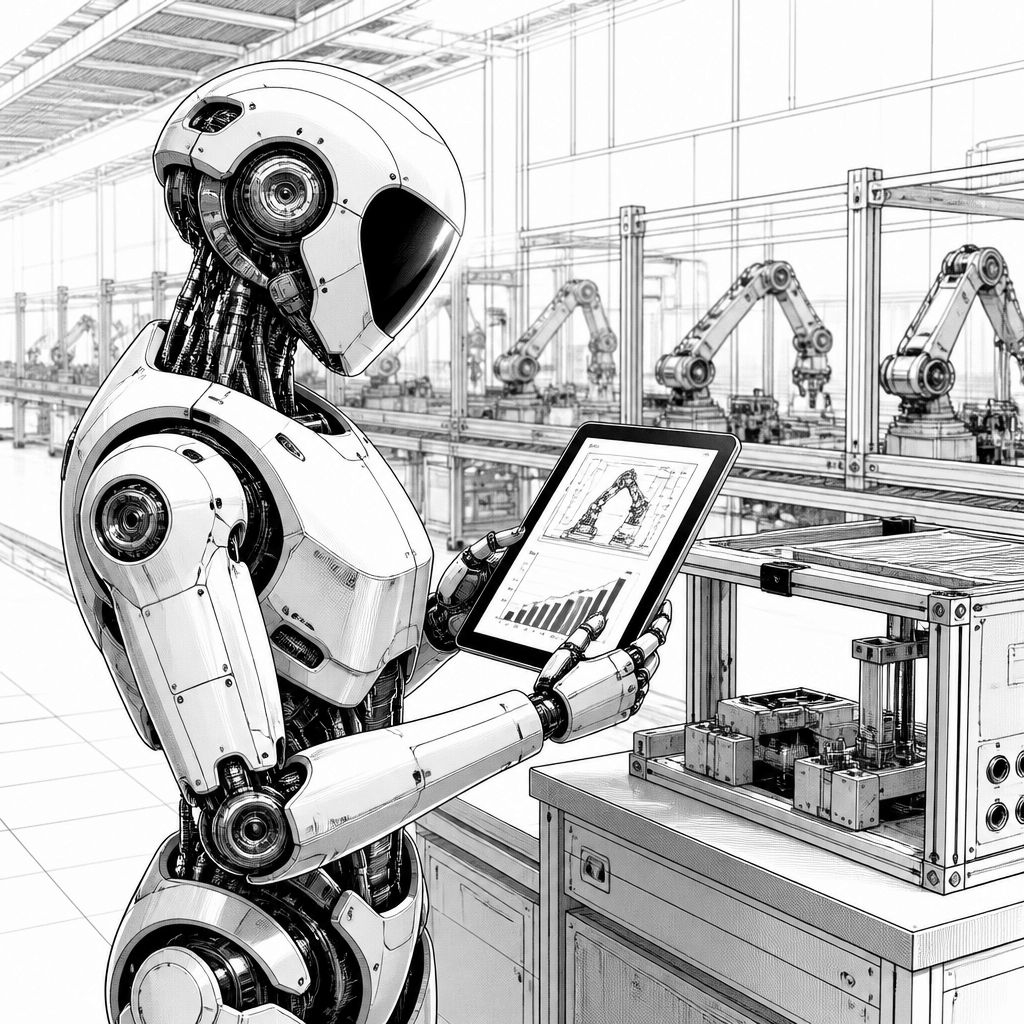
MUNICH / LONDON (IT BOLTWISE) – Munich-based robotics startup Agile Robots expects to double its revenue this year to around €600 million. The company aims to become profitable within the next two to three years, citing signed customer contracts that already support its planned growth. To date, Agile Robots says it has raised approximately US$1.5 billion from investors. In addition to industrial robots, the company is developing humanoid systems and is collaborating with Google DeepMind on this effort.
Agile Robots’ forecast focuses less on the next product demonstration and more on a key business metric: revenue is expected to increase from €300 million to approximately €600 million. The Munich startup believes this growth will enable it to achieve profitability within two to three years. According to CEO Zhaopeng Chen, the key customer contracts required for the planned expansion have already been signed. For industrial customers, this is particularly significant because it signals that robotics is no longer being marketed merely as a research or pilot project, but as a recurring delivery and operational business with predictable utilization.
From a technical perspective, Agile Robots remains primarily a robotics implementation company rather than a pure research organization. Current revenues are likely generated mainly from industrial applications—environments in which investment cycles, safety requirements, and maintenance models can be planned relatively reliably. At the same time, the company is expanding its capabilities through acquisitions. According to management, more than a dozen acquisitions have broadened its expertise. Such consolidation often addresses critical bottlenecks in robotics by rapidly combining capabilities in mechanics, sensing, control systems, and production integration, without requiring the startup to develop every component from scratch.
The company’s partner and ecosystem strategy reinforces this approach. Agile Robots has identified collaborations with Tinavi, which develops orthopedic surgical robots, and with neurosurgical robotics company Remebot. These fields differ significantly from traditional manufacturing, presenting less standardized work environments and often stricter requirements for precision, process stability, and clinical validation. The inclusion of such partners suggests that the startup aims to position its robotics platform for use across multiple domains, an approach that may also facilitate customer acquisition.
While its day-to-day business remains focused on industrial robots, the company is increasingly looking toward humanoid systems. According to Agile Robots, it is working to improve the decision-making capabilities of humanoid robots and established a partnership with Google DeepMind for this purpose earlier this year. Decision-making is a critical capability for humanoid platforms because they require more than perception alone—they must integrate goal planning, motion control, and the ability to derive robust actions from changing situations. In practice, this means that companies evaluating such systems are shifting their attention from isolated demonstrations of grasping or walking toward gradual learning and adaptation processes that remain reliable in real-world environments.
The broader market context is clear: robotics is moving beyond the prototype stage toward large-scale deployment. Agile Robots is investing not only in hardware but also in the vision that humanoid robots will eventually become mainstream. As Chen puts it, they could one day become as common on the streets as cars are today. Such statements should be understood as long-term aspirations, but they indicate the company’s strategic direction. If humanoid systems are to become mass-market products, success will ultimately depend on the combination of cost, availability, and consistently reliable performance. This also highlights the strategic importance of the company’s revenue plans: only businesses capable of scaling manufacturing and service operations simultaneously can economically finance the next generation of robots.
Over the coming months, the key question will be how effectively Agile Robots converts its planned revenue growth into operational results. The fact that customer contracts have already been signed reduces—but does not eliminate—the risk that the forecast is overly speculative. Even with confirmed orders, production, component supply, quality assurance, and deployment must all keep pace. Cost structure will also be critical. Achieving profitability requires not only revenue growth but also maintaining control over manufacturing costs, customer support, software operations, and the expenses associated with technical scaling. In this context, the startup is likely to benefit most if the capabilities acquired through its acquisitions can be rapidly integrated into repeatable implementation processes.
As a result, Agile Robots is entering a competitive environment in which both established industrial robotics companies and teams focused on humanoid robots are competing for time, talent, and customer expectations. For potential customers, not only robot performance but also economic predictability will matter. A company seeking profitability within two to three years must demonstrate that its supply chain and integration capabilities are truly designed for scale. The projected revenue figures and financing position therefore provide an important benchmark for evaluating the business. If Agile Robots successfully executes its growth contracts, its story may increasingly evolve from one centered on robotics to one focused on industrial engineering—with measurable business outcomes rather than technical promises alone.
So Europe is not behind on robots?
No, it’s not, at least when looking at industrial applications and fundamental research. It may be behind on big-name consumer-facing startups, but only maybe.